

EL DORADO
FEATURE | 138 MIN | HISTORICAL EPIC THRILLER / SURVIVAL ADVENTURE
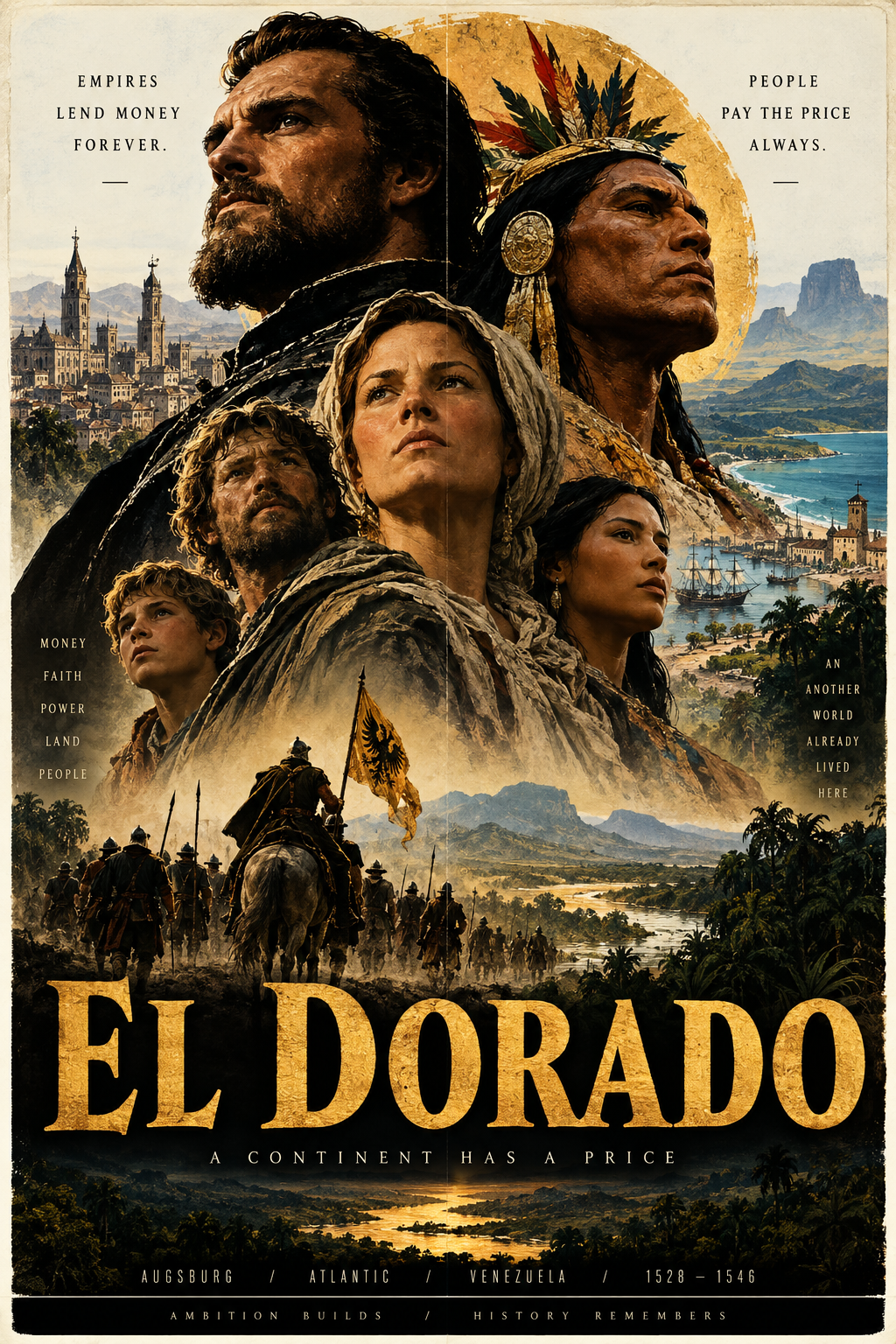
They crossed an ocean looking for gold. Eighteen years later, they were still paying for it.
LOGLINE
In 1528, when Emperor Charles V grants his German creditors extraordinary rights over Venezuela, a working-class family crosses the Atlantic seeking land while ambitious explorers hunt the legendary kingdom of El Dorado—but across eighteen years of conquest, expeditions and political collapse, their search for a city of gold consumes settlers, financiers and Indigenous communities alike, until a final generation must decide whether the promise that brought them to the New World was ever worth what it cost.
THE STORY
Augsburg, 1528. Emperor Charles V owes the Welser banking dynasty money and offers something more dangerous than repayment: Venezuela. For financiers such as Konrad Rehlinger, the imperial charter is an investment. For carpenter Jörg Kistler, his wife Grete, and their children Lukas and Anna, it is the possibility of something Europe has never given them—land of their own. Across the Atlantic, however, Manaure governs among the Caquetío within a world of families, trade and political relationships that European maps simply omit. The newcomers arrive carrying a document claiming authority over his country, while an Indigenous interpreter discovers that translation itself can become an instrument of power. As Governor Ambrosius Ehinger turns investment into conquest, rumors of unimaginable gold pull Europeans deeper inland. Expeditions disappear. Men starve. Rivers swallow horses and supplies. Ehinger dies. In Augsburg, the casualty figures enter a ledger and produce two chilling words: CONTINUE EXPEDITION. Meanwhile, the Kistlers slowly become something nobody planned. Grete becomes healer, cook and midwife. Lukas and Anna learn languages and form relationships their parents could not have imagined. The colony's children begin belonging to a place their parents still think of as foreign.
Years later, Philipp von Hutten inherits the search and gives the obsession its most seductive face. Courageous and educated, he records the name of every man who dies under his command—“Put his name down.” The growing list convinces him that finding El Dorado could transform eighteen years of suffering into sacrifice rather than waste. Jörg joins his final expedition, leaving Grete to ask the question that destroys his justification: “Have you asked the children?” The journey becomes a descent through disease, flood, starvation, mutiny, false maps and false gold until Hutten finally understands that El Dorado does not have to exist; belief in it is enough. When the survivors emerge in 1546, Spain has reclaimed the colony under Juan de Carvajal, the Kistler children have grown into adults, and Lukas can no longer understand what his father means by going “home.” Hutten's attempt to reclaim authority ends not in a heroic battle but in execution, while the Welser experiment closes exactly as it began—with ink. In Augsburg, another ledger opens. In Venezuela, the Kistlers' children continue lives among people their parents once called strangers. And Manaure turns from another approaching sail toward the life that was there all along. The land was never empty. The city of gold existed only inside the men who needed to believe in it.
THEY NEVER FOUND THE CITY OF GOLD.
They found the price of looking for it.